
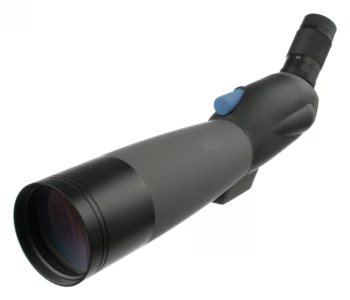
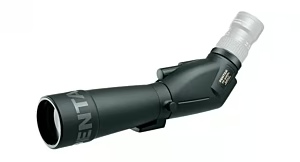

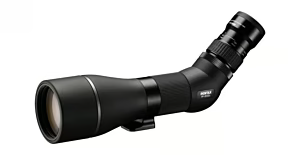
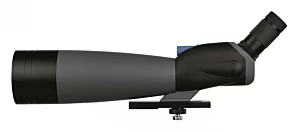

Spotting scope
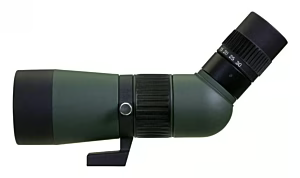
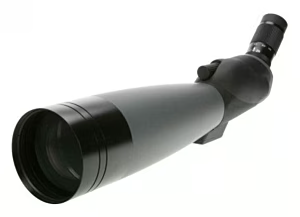
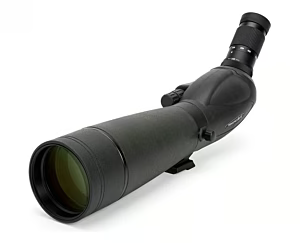
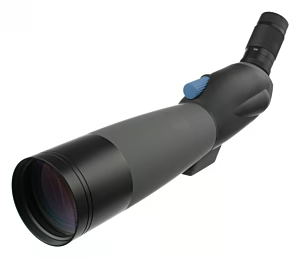
In this category you will find spotting scopes for precise nature observation, birdwatching, hunting and astronomical applications. The range includes compact travel spotting scopes as well as powerful 80 mm models from leading optics brands – all impress with high detail accuracy, weatherproof construction and excellent mechanics even under demanding conditions in Switzerland.
Whether you want to identify birds, safely assess game or study the mountain landscape: a high-quality spotting scope delivers significantly more detail than binoculars and allows hours of observation without fatigue. In this category you will find robust, waterproof and nitrogen-filled models that prove themselves in alpine terrain just as well as at the lake or in the forest. All offered spotting scopes are intended for demanding nature observers, hunters, ornithologists and amateur astronomers who value quality and durability.
The decisive factors are magnification, objective diameter, optical coating and the viewing angle. A straight viewing model is ideal for observation from raised hides or exposed points, while a 45° angled viewing is more comfortable for longer sessions and group observations. For twilight observation, lenses with at least 65 mm objective diameter are recommended. High-quality fully multi-coated optics and HD/ED glass reduce chromatic aberration and ensure a high-contrast, color-true image right to the edge.
A wide-range zoom (e.g. 20-60× or 25-75×) enables flexible scanning and targeted detailed study. For observing over long distances in the mountains, higher magnifications are useful, while a larger objective (80 mm or 82 mm) collects more light and has an advantage at twilight. More compact 60–65 mm spotting scopes are lighter and ideal for hikes where every gram counts. Also pay attention to a sharp and edge-to-edge image as well as generous eye relief so that you can observe comfortably even with glasses.
| Brand | Known for | Ideal for | Price Segment |
|---|---|---|---|
| Swarovski Optik | High-precision optics, HD glass | Demanding hunters, ornithologists | Premium |
| Zeiss | Excellent light transmission, compact | Nature observers, ambitious users | Premium |
| Leica | Brilliant contrast, compact design | Hunting, travel, twilight observation | Premium |
| Kowa | Fluorite crystal objectives, pure colors | Ornithologists, digiscoping | Mid – Premium |
| Nikon | Solid performance, robust | Beginners, birding, universal | Entry – Mid |
| Vortex | Generous warranty, shockproof | Outdoor, rough conditions | Mid |
| Meopta | Czech craftsmanship, good twilight performance | Beginners to advanced | Entry – Mid |
| Bresser | Solid basic performance | Amateur astronomers, beginners | Entry |
The category is aimed at nature observers, ornithologists, hunters, hikers and amateur astronomers looking for a powerful, portable observation device. Whether beginner or experienced user – with the selection of brands and price ranges, a suitable model can be found that enables precise insights into nature and works reliably in the often demanding Swiss terrain.
With optical devices, quality comes first. Look for multi-coating, phase correction on roof prisms and a robust, waterproof construction. All spotting scopes in this category come from renowned optics manufacturers and offer durable workmanship and precise mechanics for years of use under demanding conditions.
Please complete your information below to login.
Sign In
Create New Account