In this category you will find lenses, eyepieces, binoculars, spotting scopes and telescope accessories for nature observation, astronomy and outdoor adventures. Whether you are looking for a high-quality eyepiece for your spotting scope, need bright binoculars for bird watching or want to buy accessories for your telescope – brands such as Swarovski Optik, Zeiss, Nikon, Leica, Bushnell, Celestron, Steiner and Kowa offer one of the largest optics selections online in Switzerland. With fast delivery throughout Switzerland and the Principality of Liechtenstein.
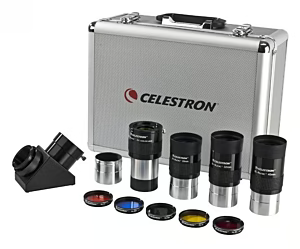
Whether you want to buy binoculars, replace a spotting scope eyepiece or upgrade your telescope with new lenses: The range covers fixed focal length eyepieces, zoom eyepieces, wide-angle eyepieces, replacement lenses as well as cleaning and care accessories. This way, as a nature observer, astronomy fan or outdoor enthusiast, you can quickly find the right optics for your purpose – conveniently from home.
Binoculars, Spotting Scopes & Telescopes – Finding the Right Eyepiece
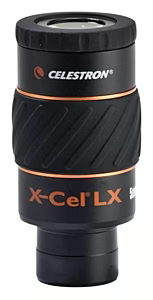
For bird watching, zoom eyepieces with 20x to 60x magnification are particularly suitable, as they allow flexible adaptation to changing distances. For astronomy, fixed focal length eyepieces with high light transmission and a large field of view are in demand. When choosing, the bayonet mount, insertion diameter and the coating of the lenses play a decisive role. Also pay attention to the exit pupil and eye relief, especially if you wear glasses.
Who Is This Category For?
This category is ideal for nature observers, bird watchers, hunters and outdoor fans in Switzerland who are looking for high-quality optics and suitable accessories. At the same time, astronomy enthusiasts, telescope owners and hobby photographers will also find a wide selection of specialised lenses and eyepieces that are often not available in local retail.
Quality, Care & Lens Coating
When buying lenses and eyepieces, it is worth paying attention to multi-layer coating, high-quality glass and solid workmanship. Regular, gentle cleaning with suitable accessories maintains optical performance for years. Invest in a good cleaning kit with a microfibre cloth, blower brush and lens cleaning fluid to avoid damaging the sensitive surfaces.
Compatibility depends on the bayonet mount of the spotting scope. Many manufacturers such as Swarovski Optik, Zeiss or Kowa use their own mounts, while others rely on universal standards. Before purchasing, check the exact model designation of your spotting scope to find the right eyepiece.
What is the difference between fixed focal length and zoom eyepieces?▾
Fixed focal length eyepieces offer a fixed magnification with usually higher image sharpness, better brightness and a larger field of view. Zoom eyepieces allow variable magnification and are more flexible in use, but often have a slightly smaller field of view and lower light transmission.
What magnification is ideal for nature observation?▾
For bird and nature observation, magnifications between 8x and 12x for binoculars and 20x to 60x for spotting scopes with zoom eyepieces are particularly popular. The choice depends on the area of use, lighting conditions and the desired level of detail recognition.
How do I clean lenses and eyepieces properly?▾
Use a soft microfibre cloth and special lens cleaning wipes. Remove coarse dust first with a blower brush or fine brush to avoid micro-scratches. Aggressive cleaning agents, household paper towels and clothing cloths are unsuitable and can damage the coating.
What do the numbers on binoculars mean (e.g. 10x42)?▾
The first number stands for the magnification (10x), the second for the objective lens diameter in millimetres (42 mm). A larger objective diameter lets in more light and ensures a brighter image, especially in twilight. The combination also determines the exit pupil and thus the viewing comfort.
Which binoculars are suitable for people who wear glasses?▾
Binoculars with a large eye relief of at least 15 to 18 mm and sufficient diopter adjustment are ideal. Many models from Nikon, Zeiss and Leica have special twist-up eyecups that can be continuously adjusted for glasses wearers and allow the full field of view even with glasses.
What is the difference between roof prism and porro prism binoculars?▾
Roof prism binoculars are more compact, more robust and usually waterproof – ideal for on the go and in changeable weather. Porro prism binoculars often offer better image quality and a more three-dimensional image at the same price, but are bulkier and heavier.
How do I find the right eyepiece for my telescope?▾
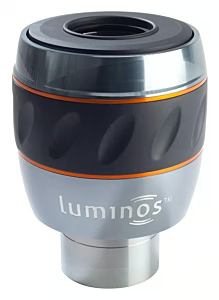
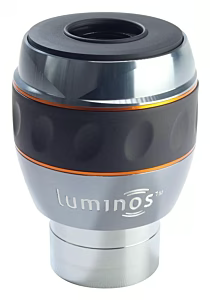
Pay attention to the insertion diameter – usually 1.25 or 2 inches – and the desired focal length. The magnification is calculated by dividing the telescope focal length by the eyepiece focal length. For astronomy, several eyepieces with different focal lengths are recommended in order to use different magnifications.
Subscribe to the newsletter
New arrivals, promotions and exclusive offers — straight to your inbox.




Please complete your information below to login.
Sign In
Create New Account